Part IV: Field Notes

What the hell was she writing? Here is some of it…and as I pull out melody lines, I’m actually listening to Ensemble Galilei… I have the youtube video on that appears below.
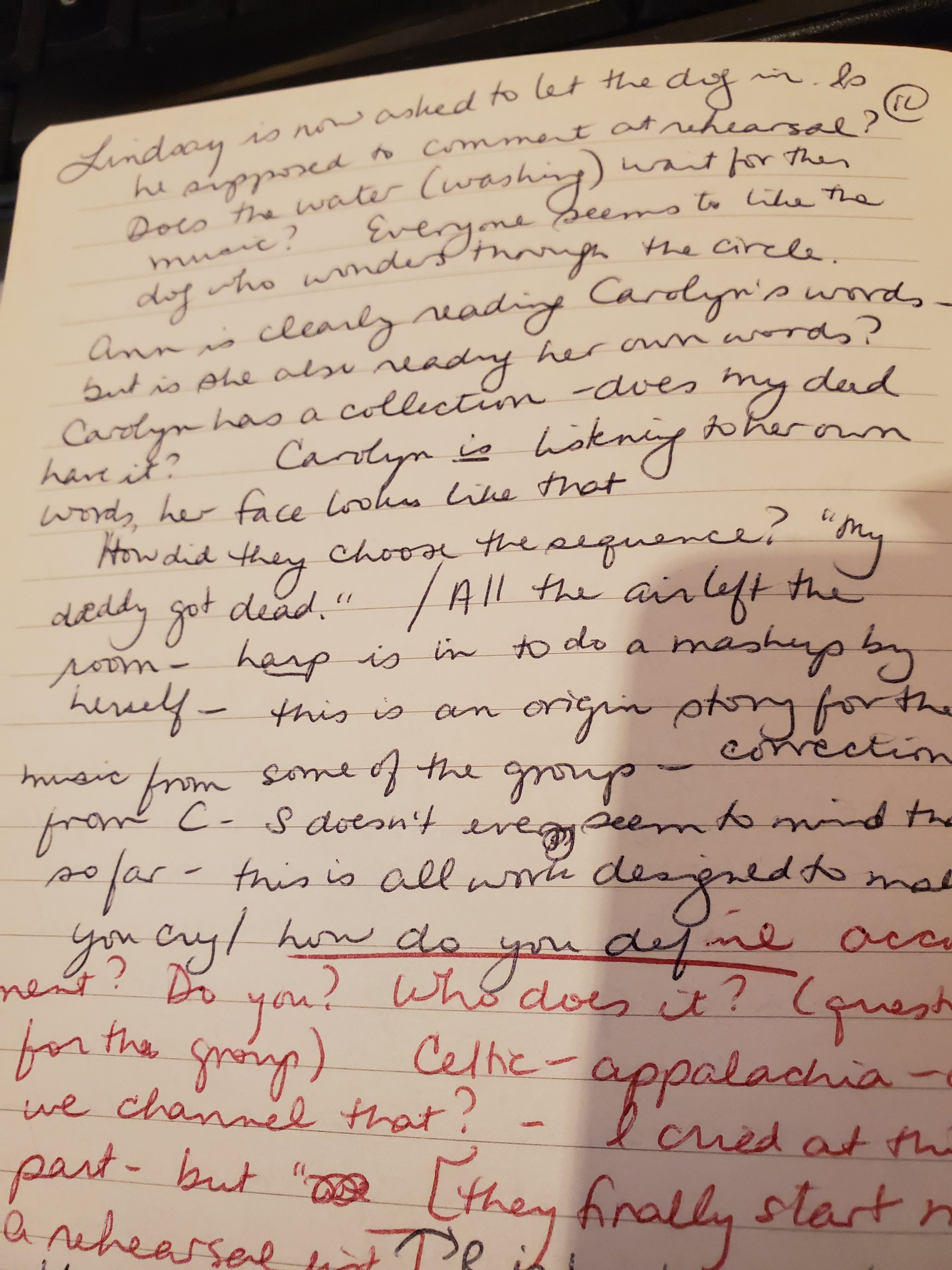
From the concert: (3/30/19, 7 PM, Baltimore, MD)

Jackie looks quite a bit more Irish tonight….Preston has the most expressive fingers: I couldn’t see that before….The men are already watching each other a bit more than they did [in rehearsal].

Everybody got their hair did.

Sue looks like she is watching the tune….When Anne and Neal perform dialogue, they move a lot more than when they read straight narration….The NPR joke gets a big laugh.

What do we [in the audience] do with these stories?

“Everyone is 6 years older.” TIME TIME TIME….EVERYTHING IS LIVE: Sue plays something, stops, Ryan–the showman: Pick a different key. The show goes on.

Music after the piece on the sniper is beautiful, Jackie has a very different sound there.

Sue somehow IS her instrument, Ryan wields his instrument, Carolyn lives through her instrument, Preston wakes up, enlivens, through his, Jackie feels at home with his. Anne steps into other people’s experiences–carefully, yet confidently. Neal hosts us.

When they sing Babylon together, a siren goes off in the distance.

Continue reading “Part IV: Field Notes”

Part III: Food for Thought

There are days when there’s not much to smile about… (Rule 3, Surrick)

Ensemble Galilei only rehearses for this week of performances once. Carolyn says it takes too much out of them to do more than that.

Carolyn is in black (she says she brings the dark energy), Jackie is in the sunglasses, Ryan is sitting up top, Sue is sitting down below. The other man in this photo is Isaac, one of their regular players-in-arms, and they are all standing in front of the VA in Los Angeles–this picture is part of a series called 25 years of EG on their website.

Anne and Neal talk to me at the restaurant about what it’s like to play the scenes, inhabit the lives of the families from Walter Reed:

Anne: Everybody gave me good advice [about performing the characters]…don’t be too dramatic…[yet] there are moments when it’s bad, when mother says “I can’t do this–“

Neal: That’s devastating. Devastating.

Anne: But the music…the interplay…changes the way we feel about it.

Continue reading “Part III: Food for Thought”

Part II:The Law of the Instrument

“It’s important to make eye contact. If you can get a soldier to look you in the eye, and you smile, he might smile back.”–Rule 3, Surrick

“Think of a theory as a tool. When you find a new tool…you want to try it out everywhere.” (Kaplan-Weinger, Ullman) Words of caution from the academy–words of challenge to an expert tool-wielder. For ethnographers, it is dangerous to get bogged down in one theory, it can be reductive and fail to capture the groups of people or individuals you study. Perhaps theories are less elegant solutions, less capable of telling stories than those instruments involving bows, strings, stretched leather, the human voice. Theories have limits, and those limits are usually sites of academic one-upmanship or sources of discontent for “studied” communities. For performers, surpassing limits or even bowing to them make the show more real. [Want more on The Law of the Instrument and Abraham Kaplan, who came up with it? See:
https://ipfs.io/ipfs/QmXoypizjW3WknFiJnKLwHCnL72vedxjQkDDP1mXWo6uco/wiki/Law_of_the_instrument.html

What I was listening to when I started this entry: Annie Lennox, Walking on Broken Glass. I was thinking about tools of storytelling–eye contact, gesture, tempo, proximity and contrasting that with the numbing effects of pain and trauma.

Right after intermission in Between War & Here, Ryan and Jackie have a face-off of sorts–fiddle and drum. They stand and face each other, following a reading about two soldiers trying to figure out to protect themselves, stay dominant. The two musicians play like lightning, it feels like you’re watching them clear the hurdles. Their instruments are barely contained, straining against the rhythm.

http://www.egmusic.com/music/the-flowers-of-the-forest/track/fjarilen/ Installment 2 of Ensemble Galilei’s music for your listening pleasure–this one is bright, fast, although the album title: Flowers of the Forest, refers to a song sung in memory of the dead.

Over dinner, Ryan describes singing, dancing, playing, art, architecture–all as forms of communication, pieces of of a universal language that changes over time, such that studying traditional music also means communicating with the past. Preston describes learning from old sounds and replicating old sounds even as he must always breathe new life into his instrument.

Continue reading “Part II:The Law of the Instrument”

Introduction: Speaking of War

An ethnographic/behind-the-scenes study of the performers of the spring 2019 tour of Between War & Here, for Ethnography of Communication, University of Maryland, Baltimore County

betweenwarandhere-bg-880x500

“What do you hope the audience gets out of this experience?”  That’s one of the questions I wrote down to ask the performers in Ensemble Galilei’s recent tour of Between War & Here.  When I actually asked the question, each performer had a specific story to communicate with the audience, to motivate a certain kind of change. 

It seems only fair that I ask myself that same question as I begin this blog, and the question is a doozy.  Stall…

I’ll try to stall beautifully…  Each blog post on my time with this incredible group will feature some of their work so you can either get to know them or get reacquainted.   This link leads you to their website, click on the Album From Whence We Came which leads you to the recording of Iris.

http://www.egmusic.com/music/

If you did click and did some exploring, you saw that Ensemble Galilei does Celtic and Early music.  They are especially drawn to mashups, taking melodies from different genres and making them talk to each other.  They play and sing, collaborating with/responding to fellow musicians, singers and speakers, as well as image collections from the Metropolitan Museum of Art, the Hubble Space Telescope, National Geographic and others.  Neal and Anne, their co-conspirators on this project, are best-known for their work as NPR correspondents; all of them operate with mega-competence at an audible frequency.

Continue reading “Introduction: Speaking of War”